Medically reviewed by Dr. Kunal Waghray, MD, DM (Pulmonary Medicine), DNB, EDRM, MNAMS, Consultant Pulmonologist and Critical Care Specialist. Last updated on 19/11/2026.
Pulmonary Rehabilitation
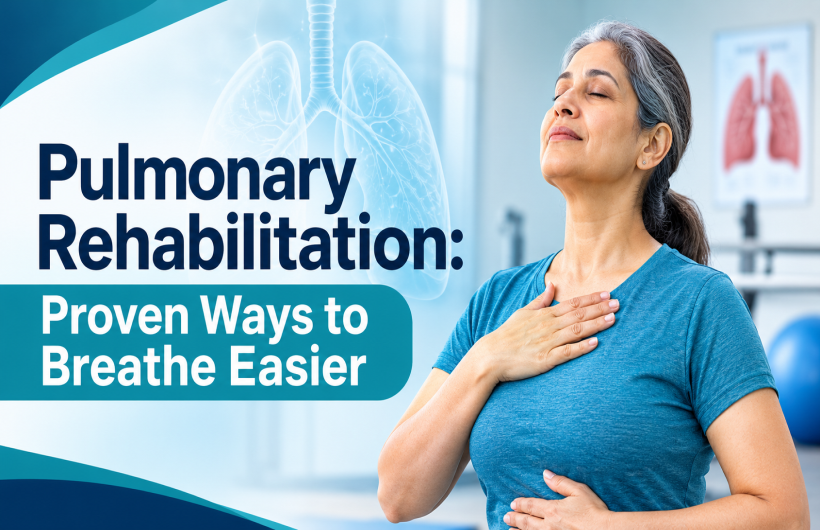
Pulmonary rehabilitation is a supervised programme of exercise, breathing training and education for long-term lung disease. It helps your body use oxygen better. It’s mainly used for breathlessness, constant tiredness and a cough that limits activity. Most people start when breathlessness limits normal tasks. The most common reason is a chronic lung condition such as COPD. Ask your doctor if you’re ready.
Care at Dr. Kunal Waghray
- Pulmonary rehabilitation in Hyderabad
- Consultations at KIMS Sunshine Hospital, Begumpet, Monday to Saturday, 9:00 AM to 5:00 PM
- Book an appointment on WhatsApp
- Evening clinics at Respire Airway Clinics, Jubilee Hills and Basheerbagh in Hyderabad
In this guide
- What is pulmonary rehabilitation?
- Who can benefit
- Assessment and tests
- Programme and benefits
- Outlook
- Keeping your gains
- Frequently asked questions
What Is Pulmonary Rehabilitation?
A physiotherapist guides a patient through a supervised walking exercise during a lung rehabilitation session.
Pulmonary rehabilitation is a structured programme that helps you stay active with a long-term lung condition. It starts with a full check of your breathing, strength and daily struggles. Your team then builds a plan around you, mixing exercise, education and support.
Lung specialists around the world describe it as care built on a thorough assessment, followed by treatments tailored to you. These include exercise training, education and help with changing habits. The aim is to improve your physical and emotional health, and to help you stay active for years. It’s used most often for COPD (chronic obstructive pulmonary disease, sometimes called emphysema or chronic bronchitis). It also helps people with other chronic lung diseases.
The evidence is strong. One large review pooled 65 studies with 3,822 people who had COPD. It found that programmes ease breathlessness and tiredness, lift mood and give people a stronger sense of control. In India, a national survey of adults aged 45 and above found airflow obstruction in 14.4% of people. Only around 11 to 12% of them had ever been told they had a lung condition. It’s never too late to ask for help.
Parts of a programme
A good programme has several parts working together. Your team may include a pulmonologist, physiotherapist, nurse, dietitian and counsellor. A programme usually includes:
- Exercise training: walking or cycling to build stamina, plus light weights for your arms and legs.
- Breathing techniques: methods such as pursed-lip breathing that help you control breathlessness.
- Education: how your lungs work, how to use inhalers well, and when to ask for help.
- Nutrition advice: eating enough to protect muscle strength, or managing weight if needed.
- Emotional support: tools for the anxiety and low mood that often come with breathlessness.
- A home plan: a routine you can follow after the supervised sessions end.
Not every programme includes all of these. Your healthcare provider will choose the mix that suits your condition and your goals.
Who Can Benefit
Two people walk together on a treadmill and a stationary bike while a nurse checks their oxygen levels.
You may benefit if breathlessness or tiredness stops you doing things you used to manage. Pulmonary rehabilitation isn’t only for people with severe disease.
Signs that rehabilitation could help
Signs could include:
- Getting out of breath on a few stairs
- Stopping to rest on short walks
- Feeling worn out by bathing or dressing
- A long-lasting cough with phlegm
- Wheezing or a tight chest when you’re active
- Avoiding outings because you fear breathlessness
- Weak arms and legs after a hospital stay for your lungs
- Feeling anxious or low about your breathing
- Needing your inhaler or nebuliser more often
- Losing weight or muscle without trying
You won’t have all of these. Other problems, such as anaemia or heart disease, can cause similar symptoms. Only a healthcare provider can tell you what’s behind them.
What are the first signs you could benefit?
Often it’s slowing down without noticing. You may stop walking to the market, or start avoiding the stairs. If breathlessness is changing your routine, speak with your provider.
Conditions that qualify
Pulmonary rehabilitation has been studied most in COPD. Reviews also show benefits in interstitial lung disease (ILD), a group of conditions that scar the lungs. Your provider may consider it for:
- COPD: the most common reason for referral, including after a flare-up that needed hospital care.
- Interstitial lung disease (ILD): a review of 16 trials found it’s safe and probably improves exercise capacity, breathlessness and quality of life.
- Bronchiectasis: when widened airways and frequent infections leave you short of breath.
- Pulmonary hypertension: when your care team agrees that supervised exercise is suitable.
- Lingering breathlessness after TB or COVID-19: once the infection itself has been treated.
- Before or after lung surgery: to build strength and stamina for recovery.
Who should be careful?
Most people can take part safely, but some conditions need a check first. Talk with your provider if you have:
- Recent chest pain or a heart attack
- Uncontrolled high blood pressure or an irregular heartbeat
- Very low oxygen levels at rest
- A current chest infection or fever
- Joint or bone problems that limit movement
- A smoking habit, since your team can help you quit
Assessment and Tests
Before you begin, your team checks how well your lungs and body cope with activity. This shows them where to start and how to measure progress.
How doctors check if you’re ready
Your first visit usually includes your medical history, a physical exam and a talk about your goals. You’ll then have breathing and walking tests. Together, they set your starting level.
Tests you may need
These tests could include:
- Spirometry: measures how much air you can blow out, and how fast.
- Six-minute walk test: shows how far you can walk and how your oxygen level changes.
- Pulse oximetry: checks your blood oxygen using a small clip on your finger.
- Symptom questionnaires: record how breathlessness affects your day and mood.
- Strength and balance checks: show how well your arms and legs are working.
You’ll repeat some of these at the end. That way, you and your team can see the change for yourselves.
Programme and Benefits
What happens in a session?
Programmes usually run for about 6 to 12 weeks, with two to three supervised sessions each week. A session may last one to two hours. It could include:
- A warm-up with gentle stretching and breathing practice
- Aerobic exercise, such as treadmill walking or cycling, with your oxygen level watched
- Strength work with light weights or resistance bands
- A cool-down and a short class on living with your condition
If you need oxygen while you exercise, your team can arrange it. They’ll raise the effort slowly, based on how you feel.
Programmes can ease breathlessness and tiredness, and many people feel more in control afterwards. After a COPD flare-up that needed hospital care, studies show better quality of life and exercise capacity. It’s also safe to start. Results on repeat hospital stays are mixed, so it isn’t a guarantee.
Ways to take part could include:
- Hospital or clinic programme: supervised sessions with close monitoring.
- Home-based programme: guided exercises at home, with regular check-ins.
- Tele-rehabilitation: video-guided sessions when travel is hard.
When should I see my healthcare provider?
See your provider if breathlessness limits your daily life, or after a hospital stay for your lungs. Don’t wait for severe symptoms. A pulmonologist in Hyderabad can check your lungs and tell you if a programme is right for you. Get urgent help for sudden breathlessness, chest pain or blue-tinged lips.
Outlook
What can I expect if I join a programme?
You may notice that you can walk further and rest less within the first few weeks. Progress is usually gradual and depends on steady effort. Your lung condition won’t disappear, but your body can use the lung function you have more efficiently. Gains fade if you stop exercising, which is why your home plan matters.
Can pulmonary rehabilitation reverse lung damage?
No. Damage such as scarring or lost air sacs generally doesn’t reverse. What improves is your muscle strength, your stamina and how you handle breathlessness. In some studies of ILD, gains were still visible six to 12 months later, though that’s less certain in idiopathic pulmonary fibrosis. Small changes in strength can make a big difference to daily life.
Keeping Your Gains
A programme can’t stop a lung condition from progressing on its own, but healthy habits help you keep your progress. Ways to keep going include:
- Doing your home exercises on most days
- Taking inhalers and medicines exactly as prescribed
- Staying away from tobacco smoke, and from outdoor air on high pollution days
- Getting the vaccines your provider recommends, such as flu and pneumonia vaccines
- Eating well and keeping a healthy weight
- Returning for review if your breathlessness gets worse
A note from Dr. Kunal Waghray
As a lung specialist in Hyderabad, I often meet people who’ve stopped doing things they love because they fear getting breathless. That fear is real, and it makes sense. Pulmonary rehabilitation helps you rebuild confidence one small step at a time.
Trial results can’t predict your own journey. Start where you are, ask questions, and lean on family and friends. Your care team is there to support you at every step.
Care at Dr. Kunal Waghray
If breathlessness is holding you back, you don’t have to manage it alone. Dr. Kunal Waghray consults at KIMS Sunshine Hospital, Begumpet, Monday to Saturday, 9:00 AM to 5:00 PM. Evening clinics run from 5:30 PM to 7:00 PM at Respire Airway Clinics, Jubilee Hills (Thursday to Saturday) and Basheerbagh (Monday to Wednesday). Call +91 76739 76695 or contact us here.
Meet Dr. Kunal Waghray, Pulmonologist & Critical Care Specialist in Hyderabad
Get expert care for bronchiectasis and other respiratory conditions. Schedule a consultation with Dr. Kunal for personalized diagnosis and treatment.
Experts You Can Trust
Medically reviewed by Dr. Kunal Waghray, MD, DM (Pulmonary Medicine), DNB, EDRM, MNAMS, Consultant Pulmonologist and Critical Care Specialist. Last updated on 19/11/2026.
Frequently Asked Questions
Who qualifies for pulmonary rehabilitation?
Adults with a long-term lung condition whose breathlessness limits daily life may qualify. COPD is the most common reason, but ILD and other chronic lung diseases can qualify too. Your doctor will review your tests before referring you.
How long does pulmonary rehabilitation take to work?
Many people notice some change within a few weeks. A full programme usually runs about 6 to 12 weeks. Benefits last longer when you keep exercising at home.
What exercises are done in pulmonary rehabilitation?
You’ll usually do walking or cycling, light strength training and breathing exercises. Your team adjusts the effort to your oxygen level and comfort. Each session also includes stretching and rest breaks.
Can I do pulmonary rehabilitation at home?
Yes, home-based and video-guided programmes exist. They work best with a proper assessment first and regular check-ins with your team. Some people start in a clinic and continue at home.
Is pulmonary rehabilitation safe?
For most people, yes. Reviews in COPD and ILD found it can be done safely when it’s supervised. Your team checks your heart rate and oxygen level and stops if something doesn’t feel right.
References
This article is based on evidence-backed sources and is reviewed by a medical professional for accuracy.
- Dowman L, Hill CJ, May A, Holland AE. Pulmonary rehabilitation for interstitial lung disease (https://doi.org/10.1002/14651858.CD006322.pub4). Cochrane Database Syst Rev. 2021;2:CD006322. Accessed 19/11/2026.
- McCarthy B, Casey D, Devane D, Murphy K, Murphy E, Lacasse Y. Pulmonary rehabilitation for chronic obstructive pulmonary disease (https://pubmed.ncbi.nlm.nih.gov/25705944/). Cochrane Database Syst Rev. 2015 Feb 23;(2):CD003793. Accessed 19/11/2026.
- Puhan MA, Gimeno-Santos E, Cates CJ, Troosters T. Pulmonary rehabilitation following exacerbations of chronic obstructive pulmonary disease (https://cochranelibrary.com/cdsr/doi/10.1002/14651858.CD005305.pub4/information). Cochrane Database Syst Rev. 2016 Dec 8;(12):CD005305. Accessed 19/11/2026.
- Sekher TV, Nichols E, Salvi S, et al. The prevalence and correlates of obstructive lung disease among adults aged 45 and above in India: findings from the Longitudinal Aging Study in India (https://pmc.ncbi.nlm.nih.gov/articles/PMC12396680/). PLoS One. 2025 Aug 29;20(8):e0327413. Accessed 19/11/2026.
- Spruit MA, Singh SJ, Garvey C, et al. An official American Thoracic Society/European Respiratory Society statement: key concepts and advances in pulmonary rehabilitation (https://doi.org/10.1164/rccm.201309-1634ST). Am J Respir Crit Care Med. 2013 Oct 15;188(8):e13-e64. Accessed 19/11/2026.
- World Health Organization. Chronic obstructive pulmonary disease (COPD) (https://www.who.int/news-room/fact-sheets/detail/chronic-obstructive-pulmonary-disease-(copd)). Accessed 19/11/2026.
Medical disclaimer: This article is for general information and education. It does not replace a consultation, diagnosis or treatment from a qualified doctor. Every person’s health is different, so please speak with Dr. Kunal Waghray or your own healthcare provider about your symptoms and treatment options. If you have a medical emergency, call your local emergency number or visit the nearest hospital right away.