




If you’ve never smoked a day in your life but you’ve had a cough hanging around for weeks or months, it’s tempting to blame it on allergies, dust, or “just Hyderabad’s air” and leave it at that. Chronic cough in non-smokers is genuinely common, and while allergies do play a role, they’re far from the only explanation, and often not even the main one. Dr. Kunal Waghray, a pulmonologist in Hyderabad at KIMS – Sunshine Hospital, Begumpet, sees patients regularly who’ve spent months trying different cough syrups and allergy tablets before finally getting a proper explanation for what’s actually causing their chronic cough.
What Counts as a Chronic Cough?
Doctors generally define a chronic cough as one lasting more than eight weeks in adults, or four weeks in children. That timeline matters because it separates an ordinary post-viral cough, which can linger for a few weeks after a cold, from something that needs a proper look.
Chronic cough in non-smokers is a slightly different diagnostic puzzle than in smokers, since the most obvious culprit is already ruled out. That doesn’t mean the cause is always minor. It just means the list of likely explanations shifts toward a specific handful of conditions.
The Real Causes of Chronic Cough in Non-Smokers
For chronic cough in non-smokers, three conditions account for the large majority of cases, often referred to together as the “cough triad”:
- Asthma, including a variant called cough-variant asthma, where cough is the primary or only symptom, without the wheezing or breathlessness people usually associate with asthma
- Postnasal drip (also called upper airway cough syndrome), where mucus from allergies, sinus issues, or chronic rhinitis drips down the back of the throat and triggers a persistent cough, often worse at night or first thing in the morning
- GERD (acid reflux), where stomach acid irritates the throat and airways, sometimes without the classic heartburn symptoms people expect to notice
Beyond these three, chronic cough in non-smokers can also stem from certain blood pressure medications (ACE inhibitors), chronic bronchitis unrelated to smoking, or less commonly, early signs of interstitial lung disease. This is exactly why “it’s probably just allergies” isn’t always the right conclusion, and why a cough lasting beyond a couple of months deserves a proper evaluation rather than another round of over-the-counter syrup.
Why This Gets Missed So Often
A big part of why chronic cough in non-smokers goes undiagnosed for so long is that patients, understandably, don’t connect a stomach or sinus issue to a lung symptom. GERD-related cough, in particular, is frequently missed because the person has no heartburn at all, just a cough that happens to be worse after meals or when lying down.
Similarly, cough-variant asthma is easy to overlook because there’s no wheeze, no obvious breathlessness, nothing that fits the picture most people have of “asthma.” The cough is the whole story, which means it often gets treated as a stubborn allergy for months before anyone tests for asthma specifically.
Warning Signs That Need Prompt Evaluation
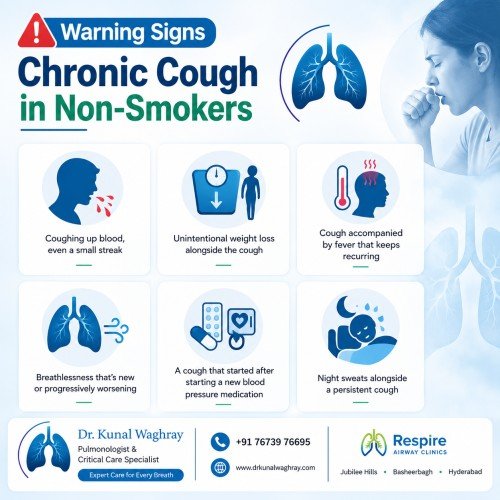
Most chronic cough in non-smokers turns out to be one of the common, manageable causes above. Still, certain features warrant quicker evaluation:
- Coughing up blood, even a small streak
- Unintentional weight loss alongside the cough
- Cough accompanied by fever that keeps recurring
- Breathlessness that’s new or progressively worsening
- A cough that started after starting a new blood pressure medication
- Night sweats alongside a persistent cough
None of these are common causes of an ordinary chronic cough, which is exactly why they’re worth flagging rather than waiting out.
How Dr. Waghray Diagnoses the Cause
Dr. Kunal Waghray typically starts by taking a detailed history, when the cough started, what makes it better or worse, whether it’s worse at night, after meals, or with certain triggers, since the pattern itself often points strongly toward one of the three main causes. A chest X-ray helps rule out structural issues, and a pulmonary function test can confirm or rule out asthma, even the cough-only variant. Where reflux is suspected, treatment often begins as a trial rather than requiring invasive testing upfront, since a good response to acid-suppressing treatment is itself useful diagnostic information.
Treatment is directed at the underlying cause rather than the cough itself. Asthma-driven cough responds to inhaled therapy, postnasal drip to antihistamines or nasal sprays depending on the trigger, and GERD-related cough to dietary changes and acid-reducing medication. Cough suppressants alone rarely solve chronic cough in non-smokers, because they mask the symptom without addressing what’s actually causing it.
What to Expect During Treatment
Most patients see meaningful improvement within two to four weeks once the right cause is identified and treated appropriately, though GERD-related cough can take a bit longer to settle fully. If the first treatment tried doesn’t help, that’s useful information too. It often means testing for the next most likely cause on the list rather than a treatment failure.
The Takeaway
Chronic cough in non-smokers almost always has a clear, treatable explanation once the right questions are asked, even when it isn’t the allergies you’ve been blaming it on. If your cough has outlasted a couple of cold seasons and cough syrup isn’t cutting it anymore, it’s worth getting properly evaluated. Dr. Waghray sees patients for persistent cough evaluation at KIMS – Sunshine Hospital, Begumpet, Monday to Saturday. Contact us to book a consultation, or WhatsApp us with your questions first.
Meet Dr. Kunal, Pulmonologist & Critical Care Specialist in Hyderabad
Get expert care for bronchiectasis and other respiratory conditions. Schedule a consultation with Dr. Kunal for personalized diagnosis and treatment.
Frequently Asked Questions
Q: How long is too long for a cough before I should see a doctor?
A: A cough lasting more than eight weeks in adults is generally considered chronic and worth a proper evaluation, especially if it hasn’t responded to typical allergy or cold treatments.
Q: Can GERD really cause a cough without any heartburn?
A: Yes, this is actually common. Acid reflux can irritate the throat and airway enough to trigger a persistent cough without the classic burning sensation most people associate with GERD.
Q: I don’t wheeze at all, so it can’t be asthma, right?
A: Not necessarily. Cough-variant asthma presents with cough as the only symptom, without wheezing or breathlessness, which is exactly why it’s often missed for months.
Q: Is chronic cough in non-smokers ever a sign of something serious like lung cancer?
A: It’s uncommon, especially in non-smokers, but persistent cough combined with weight loss, coughing blood, or breathlessness should be evaluated promptly to rule out less common causes.
Q: Do I need to stop my blood pressure medication if it’s causing my cough?
A: Don’t stop any medication on your own. If an ACE inhibitor is suspected as the cause, your doctor can guide switching to an alternative safely.
This content is for educational purposes and isn’t a substitute for an in-person medical consultation. Please see a pulmonologist for diagnosis and treatment tailored to your condition.