
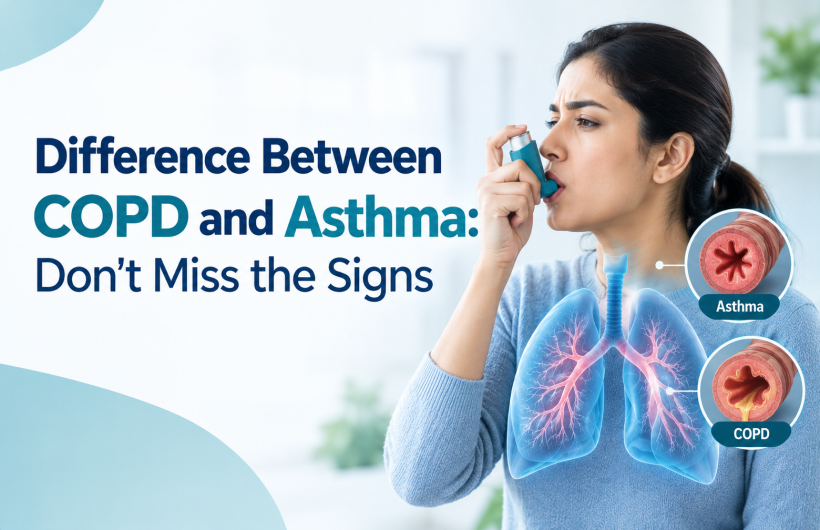
The difference between COPD and asthma comes down to how the airways behave. In asthma, the airways narrow in episodes and usually open up again, either on their own or with a reliever inhaler. In COPD, the airways and lung tissue are permanently damaged, usually by years of smoke or air pollution, so the blockage stays and slowly worsens. Both cause cough, wheeze and breathlessness, which is why many patients who visit a pulmonologist in Hyderabad have been treated for the wrong condition for years. Getting this right changes your medicines, your outlook and how closely you need follow-up.
Asthma vs COPD at a Glance: What Is Actually Different?
| Asthma | COPD | |
|---|---|---|
| Usual age at start | Childhood or young adulthood, but it can begin at any age | Usually after 40 |
| Common causes | Allergies, family history, sensitive airways | Smoking, kitchen smoke, air pollution, dust, past TB |
| Symptom pattern | Comes and goes, often worse at night or early morning | Present most days, slowly gets worse |
| Airflow blockage | Largely reversible | Only partly reversible, and progressive |
| Cough | Dry, often triggered by dust, cold air or exercise | Daily, often with phlegm |
| Allergies, eczema, hay fever | Common | Not typical |
| Long-term outlook | Often well controlled, with long symptom-free spells | Cannot be cured, but treatment slows it down |
Why Do Asthma and COPD Feel So Similar?
Asthma and COPD both are obstructive lung diseases. The airways are narrowed, so air gets out slowly and you feel short of breath, wheeze or cough.
A patient in his 50s told me he had “asthma for 15 years” because his chest tightened every winter. His breathing test showed COPD from decades of beedi smoking. The symptoms were the same as asthma, but the lung damage underneath was different.
Some people also have both conditions together. When that happens, the treatment plan has to cover both.
What Causes of Each Condition Asthma and COPD
Asthma often runs in families and is linked to allergies. Dust mites, pollen, mould, smoke and strong smells are common triggers. Hyderabad’s construction dust, traffic fumes and monsoon dampness set off symptoms in many of my asthma patients.
COPD is mostly caused by long-term exposure to irritants. Smoking is the biggest cause, but not the only one. In India, these also lead to COPD:
- Years of cooking over wood, charcoal or dung-cake fires
- Heavy air pollution
- Dust and fumes at work, such as in construction, textile or chemical jobs
- Lung scarring after tuberculosis
So a non-smoker can absolutely have COPD. If you want the full background on the condition itself, our guide on what is COPD covers causes and prevention in detail.
Which Symptoms Point to Asthma and Which Point to COPD?
Signs that lean toward asthma:
- Wheezing or chest tightness in episodes, with normal breathing in between
- Symptoms that wake you at night or are worst in the early morning
- Flare-ups after dust, cold air, exercise or an allergy exposure
- Symptoms that started in childhood or came with sneezing and itchy eyes
Signs that lean toward COPD:
- Breathlessness that builds slowly and does not fully go away
- A daily cough with phlegm, often for months or years
- A history of smoking or long exposure to smoke
- Chest infections that keep coming back, especially in winter
None of these signs settles the question alone. That is why a test matters more than a guess.
How Do Doctors Confirm the Difference Between COPD and Asthma?
The reliable way is a lung function test called spirometry. You blow hard into a machine, and it measures how much air you can breathe out and how fast. Then you take a bronchodilator inhaler and repeat the test.
In asthma, the numbers usually improve clearly after the inhaler. In COPD, the improvement is small and the airflow stays below normal even after the medicine. Our guide to the spirometry test for lung function explains the procedure step by step.
Spirometry is paired with your history, a chest examination and often a chest X-ray. Sometimes we need extra tests such as allergy testing or a CT scan, especially when symptoms do not fit neatly into one condition.
What Dr. Kunal Waghray Checks During Your First Visit at KIMS Hospital
I begin with your story: when the symptoms started, what sets them off, whether you smoke or ever did, how you cook at home and what work you do. Then we do spirometry and examine your chest.
How Is Treatment Different for Asthma and COPD?
Both conditions use inhalers, but the plan is not the same.
Asthma treatment usually includes:
- An inhaler with a steroid to calm airway inflammation every day, plus a quick reliever for flare-ups. Relying on a reliever alone is not advised, because it leaves the inflammation untreated.
- Finding and reducing your triggers
- For severe asthma that stays uncontrolled, add-on options such as biologic medicines or bronchial thermoplasty, after a proper assessment
COPD treatment usually includes:
- Long-acting bronchodilator inhalers used every day. A steroid is added only for selected patients, such as those with frequent flare-ups.
- Stopping smoking, which is the single most effective step
- Flu and pneumococcal vaccines, and pulmonary rehabilitation to build stamina
- Oxygen therapy when blood oxygen runs low
- For selected patients with advanced emphysema, procedures such as bronchial thermovapor ablation
Results depend on how advanced the disease is and on the individual patient, so treatment is always tailored.
When Is Breathlessness an Emergency?
Go to the nearest emergency department without waiting for an OPD slot if you have:
- Breathlessness so severe that you cannot finish a sentence
- Lips or fingertips turning blue or grey
- No relief from your reliever inhaler after repeated doses
- Confusion, unusual sleepiness or a racing heartbeat with breathlessness
Conclusion
If you are breathless, wheezing or coughing most days, do not settle for “it is just asthma” or “it is just age” without a lung function test. Knowing the difference between COPD and asthma decides which inhaler works for you and how to protect your lungs from here.
Dr. Kunal Waghray sees patients at KIMS – Sunshine Hospital, Monday to Saturday. You can book an appointment or call +91 76739 76695 to reserve a slot. If you would like to send your recent reports first, you can WhatsApp us.
Meet Dr. Kunal Waghray, Pulmonologist & Critical Care Specialist in Hyderabad
Get expert care for bronchiectasis and other respiratory conditions. Schedule a consultation with Dr. Kunal for personalized diagnosis and treatment.
Frequently Asked Questions
What is the difference between COPD and asthma in simple words?
Asthma is a condition where airways become sensitive and tighten in episodes, and they usually reopen. COPD is permanent damage to the airways and air sacs, usually from smoke or pollution, and it worsens slowly over time.
Can asthma turn into COPD?
Asthma does not automatically become COPD. However, poorly controlled asthma over many years, especially in someone who smokes, can leave some permanent airway narrowing. Good control early on lowers that risk.
Can a person have both asthma and COPD?
Yes. Some patients have features of both, and they often have more frequent flare-ups. They need a treatment plan that covers both conditions, usually including an inhaled steroid.
Can non-smokers get COPD?
Yes. Smoke from cooking fuel, air pollution, workplace dust and past tuberculosis can all damage the lungs enough to cause COPD, even in people who have never smoked.
Which test shows whether it is asthma or COPD?
Spirometry, done before and after a bronchodilator inhaler, is the key test. Your doctor reads it together with your age, history and symptoms.
Are asthma and COPD curable?
Neither is cured in the usual sense. Asthma can often be controlled so well that you live almost symptom-free, while COPD can be slowed and made much more comfortable with the right treatment.
This article is for education only and does not replace an in-person consultation. Please see a doctor for diagnosis and treatment.