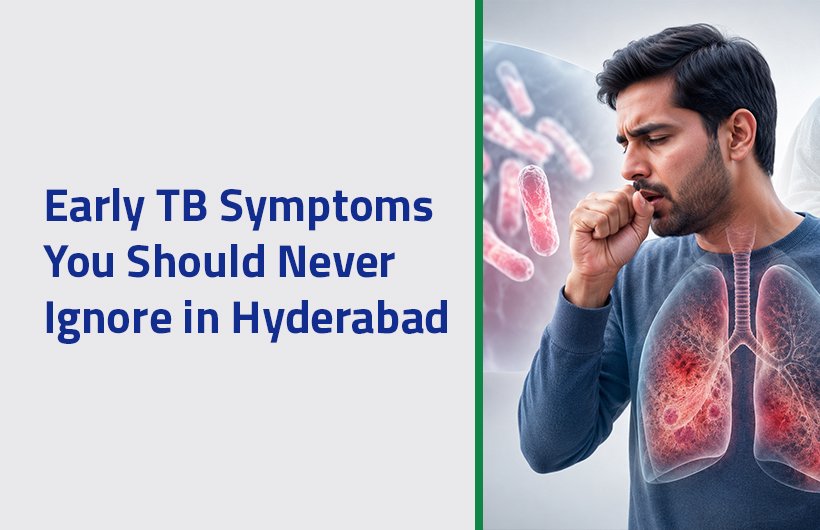



Most people who come in with tuberculosis waited too long to come in. Not because they ignored their body, but because the early symptoms of TB feel almost identical to a cold or a low-grade viral infection. A cough, some fatigue, maybe a mild fever. Easy to explain away. Easy to wait out.
The difference is that a cold resolves in 7 to 10 days. TB doesn’t. If you or someone in your family has had a cough that lasts more than two weeks, seeing a TB specialist doctor in Hyderabad isn’t overreacting; it’s the right first move. As a pulmonologist in Hyderabad who manages TB cases regularly, the most common thing I hear is: “I thought it would pass on its own.”
Here’s how to tell the difference and when to stop waiting.
Why TB Is Easily Missed in the Early Weeks
Tuberculosis is caused by Mycobacterium tuberculosis, a slow-growing bacterium that primarily targets the lungs. Because it progresses gradually, the first few weeks of infection rarely feel alarming.
The early symptoms, cough, mild fatigue, and low-grade fever, overlap so heavily with a common cold or chest infection that most patients (and sometimes even general physicians) don’t flag it as TB initially. Unlike a cold, which hits hard for a few days and clears, TB symptoms tend to be quieter and persistent, building slowly over weeks.
India carries 26% of the world’s TB burden, with around 2.7 million new cases diagnosed every year, according to the WHO. Hyderabad, as a high-density urban center with crowded public transport, dense housing in several localities, and significant daily population movement, creates the kind of close-contact conditions where TB spreads easily.
This isn’t a rare disease. It’s a common one that gets misread as something minor.
The Symptoms That Set TB Apart from a Cold
A viral cold and pulmonary TB can cause both cough and fatigue. Here’s where the similarity ends:
A typical cold:
- Peaks within 2 to 3 days
- Comes with a runny nose, sore throat, or sneezing
- Resolves fully within 7 to 10 days
- Doesn’t cause significant weight loss
- Doesn’t cause night sweats
TB symptoms that cross a line:
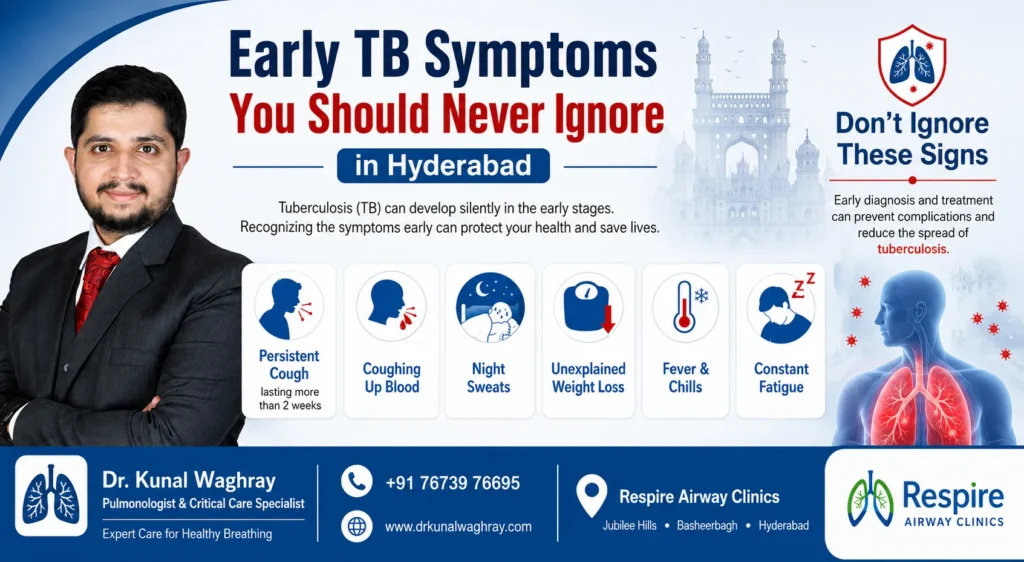
- Cough lasting more than 2 to 3 weeks, this is the single most important red flag
- Blood or rust-colored streaks in sputum, even a small amount, warrants urgent testing
- Night sweats: drenching sweats that require changing clothes, even on cool nights
- Unexplained weight loss, losing weight without dieting or trying, especially noticeable over 2 to 4 weeks
- Low-grade fever in the evenings often 99°F to 100°F, not the high fever of a flu
- Persistent fatigue is not the tiredness of a busy week, but a deeper exhaustion that rest doesn’t fix
- Chest pain, particularly on breathing deeply or coughing
You don’t need all of this to guarantee a test. A cough lasting more than two weeks, combined with any one of the above symptoms, is enough reason to get checked immediately.
The TB Symptoms That Are Easiest to Dismiss
Among the symptoms listed above, two are dismissed most often.
Night sweats are frequently attributed to the weather, stress, or “sleeping too hot.” In a city like Hyderabad, where warm nights are common, patients genuinely don’t think twice about waking up damp. But TB-related night sweats are typically severe enough to soak clothing or bedsheets, and they happen repeatedly, not once or twice.
Weight loss is often attributed to diet changes, stress, stomach upset, or just “not eating well lately.” TB-related weight loss can occur even when appetite seems relatively normal because the body is fighting an active infection. A 3- to 4-kg loss over a few weeks without explanation is worth taking seriously.
Neither of these symptoms shows up with a cold. If you’ve had a prolonged cough and either of these, get tested.
Who Is at Higher Risk of TB in Hyderabad
TB doesn’t discriminate, but some circumstances increase exposure risk:
- Close contact with a confirmed TB patient, family members, colleagues, or housemates
- Living or working in crowded, poorly ventilated spaces, shared dormitories, dense urban housing, or older office buildings
- Immunocompromised conditions, such as diabetes, HIV, long-term steroid use, or recent chemotherapy, all reduce the body’s ability to contain TB bacteria
- History of TB: previously treated TB that wasn’t completed or was inadequately treated carries a relapse risk
- Children, especially under five, are more vulnerable to severe forms of TB
If any of these apply, the threshold for getting tested should be lower even if the cough seems mild.
What Happens If TB Is Caught Late
Early-stage TB, when bacteria counts are still low and lung involvement is limited, is significantly easier to treat. A standard six-month course of antibiotics, taken consistently, clears up in many cases.
When TB is caught late, or when treatment is started and then stopped partway through, the risk of drug-resistant TB increases sharply. Multi-drug-resistant TB (MDR-TB) requires a much longer treatment course, is more difficult to manage, and carries a worse prognosis.
This is why timing matters far more than most patients’ realis. An uncomfortable six months of treatment for standard TB is categorically better than navigating drug resistance.
How TB Is Diagnosed and Why a Specialist Makes a Difference
If TB is suspected, a general physician will typically start with a sputum test and a chest X-ray. These are the right first steps and catch many cases.
Where it gets more complex is smear-negative TB cases, where the initial sputum test comes back negative, but clinical suspicion remains high. This happens more often than people expect, particularly in patients with early-stage infections or those who can’t produce adequate sputum samples.
In these situations, advanced diagnostic tools like CBNAAT/GeneXpert, bronchoscopy, or EBUS (endobronchial ultrasound) become necessary. Bronchoscopy allows a pulmonologist to examine the airways directly and obtain samples from the deep lung or surrounding lymph node areas that sputum tests simply can’t reach. This is also understanding the difference between a pulmonologist and a general physician also becomes clinically relevant for a TB workup.
Dr. Kunal Waghray performs advanced interventional bronchoscopy and EBUS procedures at KIMS – Sunshine Hospital, Begumpet, procedures that are critical for diagnosing TB in cases where standard tests are inconclusive.
If you’re unsure whether your symptoms warrant a specialist visit, this guide on warning signs that mean it’s time to see a pulmonologist can help you decide
Struggling with Breathing Problems?
Don’t ignore persistent cough, shortness of breath, wheezing, chest tightness,
or recurring lung infections. Get expert evaluation and personalized treatment
from Dr. Kunal Waghray, Pulmonologist & Critical Care Specialist in Hyderabad.
Frequently Asked Questions
Q: How long does a cough need to last before I consider TB?
A: Any cough lasting more than two to three weeks without a clear cause, like a resolved infection, should be investigated. The threshold drops further if you also have night sweats, weight loss, or blood in your sputum.
Q: Can TB spread through casual contact like sharing a room briefly?
A: TB spreads through airborne droplets from prolonged close contact with an active TB patient or repeated exposure in an enclosed space, like shared living quarters or long hours in a small office. Briefly, passing contact carries a much lower risk, though it is not zero for very infectious cases.
Q: My sputum test came back negative. Does that mean I don’t have TB?
A: Not necessarily. A negative sputum smear doesn’t rule out TB, particularly in early-stage infection. If clinical suspicion remains, a GeneXpert (CBNAAT) test, chest CT scan, or bronchoscopy may be needed to confirm or exclude the diagnosis.
Q: Is TB treatment available through the government for free in Hyderabad?
A: Yes. Tuberculosis treatment under India’s National TB Elimination Programmer (NTEP) is available free of cost at government health centers across Telangana. Nikshay Poshan Yojana also provides nutritional support during treatment. A specialist can help ensure you’re in the right regimen, whether treated through public or private healthcare.
Q: Can someone with diabetes get TB more easily?
A: Yes. Diabetes significantly increases the risk of TB infection and the risk of TB progressing from latent to active disease. People with diabetes should have a lower threshold for TB testing when respiratory symptoms appear, and TB-diabetes co-management requires careful coordination between specialists.
Q: If I’ve had TB before and completed treatment, can I get it again?
A: Yes. Prior TB does not provide immunity against reinfection. If symptoms return, especially cough, weight loss, or night sweats, get evaluated promptly. Relapses after incomplete treatment also carry a higher risk of drug resistance.
Conclusion
A cough that outlasts a cold, night sweats you keep brushing off, a few unexplained kilos lost individually, these are easy to dismiss. Together, they form a pattern that needs medical attention, not more waiting.
India carries the world’s largest TB burden. Hyderabad is a high-density city where bacteria move easily between people in shared spaces. Early testing is the single most effective thing you can do both for yourself and for anyone living or working closely with you.
If your cough has gone on longer than it should have, contact us to book a consultation with Dr. Kunal Waghray at KIMS – Sunshine Hospital, Begumpet, or reach us directly on WhatsApp for a quicker response.
Disclaimer: This article is for informational purposes only and does not constitute medical advice. For any symptoms mentioned above, please consult a qualified medical professional for proper diagnosis and treatment.