



Many patients come to me after months of a nagging dry cough and slowly worsening breathlessness, often saying it was “just aging” or mild asthma.
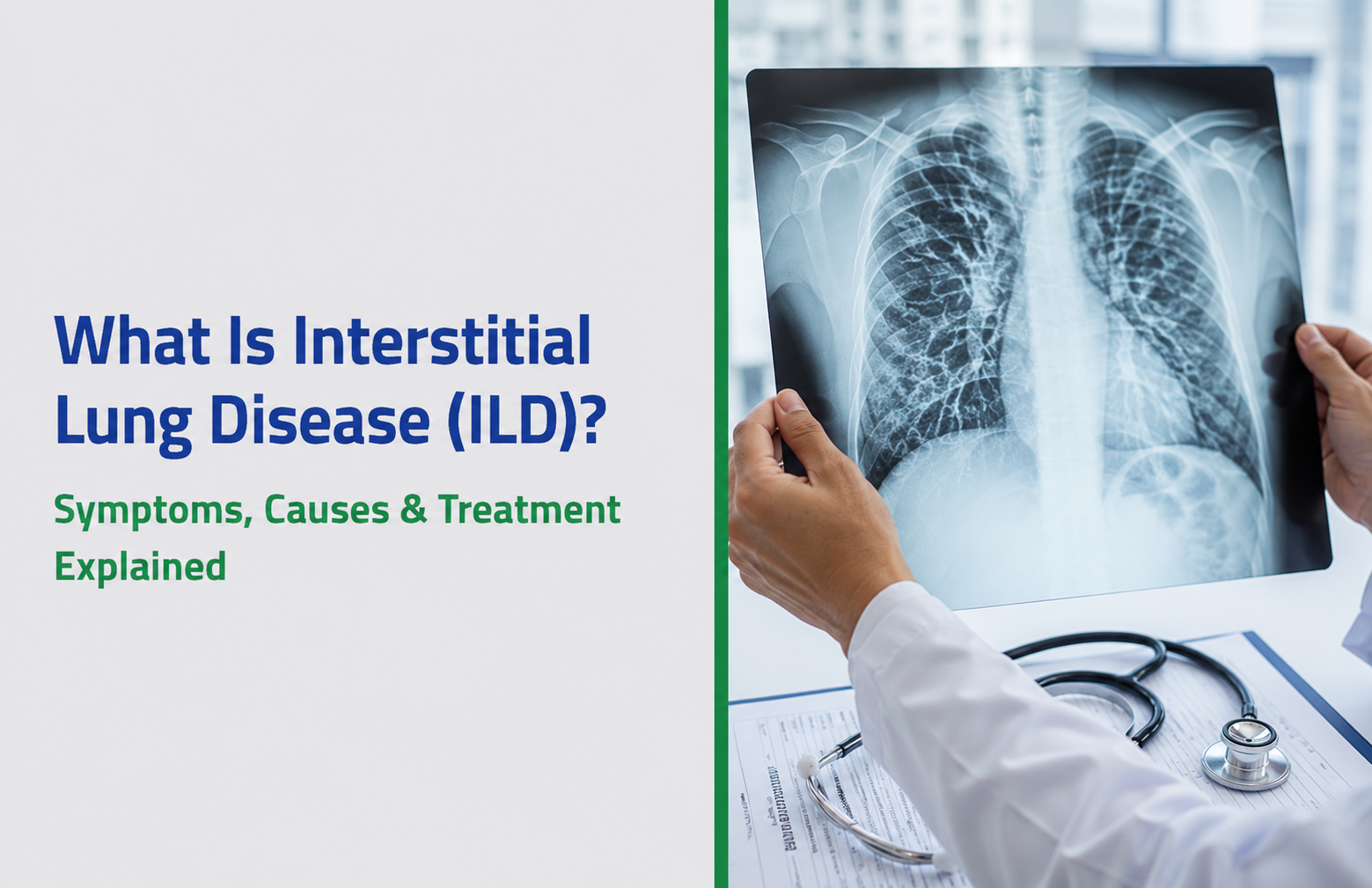
But when the HRCT scan comes back showing lung scarring, everything changes.
As a Pulmonologist in Hyderabad, I see this pattern far too often, with interstitial lung disease symptoms being dismissed until significant damage has already occurred.
ILD is not a disease. It is a group of over 200 lung conditions, all sharing one common feature: scarring and inflammation of the lung tissue. If you or someone you love has been experiencing unexplained breathlessness or a persistent dry cough, understanding interstitial lung disease and its treatment early can make a real difference to quality of life.
What Is Interstitial Lung Disease (ILD)?
ILD refers to a broad group of disorders that damage the interstitium of the delicate tissue surrounding the tiny air sacs (alveoli) in your lungs.
When this tissue becomes inflamed or scarred:
- The lungs stiffen and lose their ability to expand properly
- Less oxygen reaches your bloodstream with every breath
- Daily activities, energy levels, and even heart function are affected over time
How Is ILD Different from Asthma or COPD?
This is one of the most common questions I have.
Asthma and COPD primarily affect the airways in the tubes through which air travels. ILD is different. It affects the lung tissue itself by holding everything together. This is why ILD does not respond to inhalers the way asthma does, and why a correct diagnosis matters so much.
Common Interstitial Lung Disease Symptoms to Watch For
The challenge with ILD is that its symptoms develop slowly and are easy to dismiss. Here is what to look out for:
| Symptom | What It Feels Like |
| Shortness of breath | Starts during activity (stairs, walking); worsens with rest over time |
| Dry, persistent cough | Non-productive, no mucus, continuous, and exhausting |
| Fatigue | Constant breathlessness drains energy, even after a full night’s sleep |
| Unexplained weight loss | Gradual, with no clear dietary reason |
| Finger clubbing | Fingertips appear wider or rounder, a sign of low oxygen levels |
When Should You Be Concerned?
One pattern I explain to every patient at KIMS – Sunshine Hospital and Respire Airway Clinics:
If your breathing has gradually worsened over weeks or months, do not assume it is fitness or age. Get your lungs assessed by a specialist.
What Causes ILD? Understanding the Risk Factors
ILD has many possible causes and, in some cases, no identifiable cause at all.
-
Autoimmune & Connective Tissue Diseases
Conditions like rheumatoid arthritis, lupus, and scleroderma are frequently linked to ILD. The immune system attacks healthy lung tissue as part of a broader inflammatory process.
-
Occupational & Environmental Exposures
Long-term inhalation of:
- Coal dust or silica
- Asbestos fibers
- Grain dust or mold spores
…can trigger lung inflammation, sometimes called hypersensitivity pneumonitis or occupational lung disease.
-
Medications
Certain drugs can cause lung damage as a side effect, including:
- Some chemotherapy agents
- Heart medications (e.g., amiodarone)
- Certain anti-inflammatory drugs
-
Smoking
Cigarette smoking raises the risk of several types of ILD and accelerates progression in those diagnosed.
-
Idiopathic (Unknown) Causes
When no trigger is identified, the most common form is idiopathic pulmonary fibrosis (IPF), a progressive scarring condition requiring specialist management.
Studies in India show ILD prevalence ranges from 49 to 98 per 100,000 people, with incidence rising steadily over the past two decades. Early diagnosis is critical.
How Is ILD Diagnosed?
Diagnosing ILD takes a careful, stepwise approach. When patients visit my clinic, I start with a detailed history:
- Occupation and workplace exposures
- Home environment (mold, birds, dust)
- Smoking history
- Family history of lung or autoimmune disease
Key Diagnostic Tests
- High-Resolution CT scan (HRCT): The most important imaging test for ILD. It reveals the pattern and extent of lung scarring with far greater detail than a standard chest X-ray.
- Pulmonary Function Tests (PFTs) A spirometry test for lung function measures how well the lungs expand and how efficiently they transfer oxygen. In ILD, lung capacity is typically reduced.
- Blood Tests Help identify autoimmune markers or specific antibodies pointing to an underlying cause.
- Bronchoscopy or Lung Biopsy In selected cases, I may recommend examining lung tissue directly to confirm the specific type of ILD.
Getting the diagnosis right matters enormously because treatment varies significantly depending on the type of ILD involved.
Treatment Options for Interstitial Lung Disease in Hyderabad
There is currently no cure that reverses existing lung scarring. However, the right treatment started early can significantly slow progression and improve breathing.
Available Treatments
Anti-inflammatory & Immunosuppressant Medications: for ILD caused by autoimmune conditions, these drugs reduce immune activity, control inflammation, and limit further scarring.
Antifibrotic Medications: For idiopathic pulmonary fibrosis specifically, drugs like pirfenidone and nintedanib slow the rate of scarring. They are not curative, but they make a meaningful difference to disease trajectory.
Supplemental Oxygen Therapy: When blood oxygen levels drop, supplemental oxygen therapy can improve energy, sleep quality, and exercise capacity.
Pulmonary Rehabilitation: A structured program combining breathing exercises, physical conditioning, and patient education, helping maintain function and quality of life.
Lung Transplantation: For advanced, end-stage ILD, a lung transplant remains a life-saving option. I work closely with transplant teams and can guide appropriate patients through this pathway.
Understanding lung infection symptoms is also essential for ILD patients, as respiratory infections can quickly worsen an already compromised lung.
If you have been told you may have ILD or are experiencing symptoms, don’t wait. Reach out to us directly via WhatsApp to book an appointment at KIMS – Sunshine Hospital, Begumpet, or Respire Airway Clinics, Jubilee Hills.
Conclusion:
Living with interstitial lung disease can feel uncertain, especially in the early stages when answers are hard to come by.
At my clinics in Hyderabad, my goal is to give every patient a clear diagnosis, an honest picture of what to expect, and a treatment plan tailored to their specific type of ILD.
As a trusted best chest physician in Hyderabad, I believe that knowledge, early action, and the right specialist support make the greatest difference.
Don’t wait for symptoms to limit your daily life. Contact us today. I scheduled a consultation and took the first step toward breathing better.
Frequently Asked Questions About Interstitial Lung Disease Symptoms
Q: Is interstitial lung disease curable?
ILD cannot currently be cured, as existing lung scarring cannot be reversed. However, many patients live well for years with the right treatment. Early diagnosis and specialist management can slow progression, control symptoms, and significantly improve quality of life.
Q: How do I know if my breathlessness is ILD or asthma?
Asthma affects the airways and typically responds well to inhalers. ILD affects the lung tissue itself and causes gradually worsening breathlessness that does not respond to inhalers. An HRCT scan and spirometry test will give a clear answer.
Q: Can ILD be caused by rheumatoid arthritis or lupus?
Yes. Autoimmune conditions like rheumatoid arthritis, lupus, and scleroderma are among the most common causes of ILD. If you have an autoimmune condition and notice progressive breathlessness or a dry cough, your lungs should be evaluated promptly by a pulmonologist.
Q: What tests are needed to diagnose ILD?
Diagnosis typically involves an HRCT scan, pulmonary function tests (spirometry and DLCO), blood tests for autoimmune markers, and sometimes a bronchoscopy or lung biopsy. A specialist determines which combination is most appropriate for your case.
Q: How fast does ILD progress?
Progression varies widely by type. Some forms, like hypersensitivity pneumonitis, can stabilize or partially improve when the trigger is removed. Others, like idiopathic pulmonary fibrosis, tend to progress steadily. This is why an accurate, early diagnosis is essential.