




That cough that never fully leaves, the one that brings up mucus every morning and flares into a chest infection every few months, might not be “just a weak chest.” It could be bronchiectasis, a condition where the airways widen and lose their ability to clear mucus properly, setting up a cycle of repeated infections. Many patients spend years cycling through antibiotics before anyone connects the dots, in part because it looks so similar to chronic bronchitis on the surface. Getting proper bronchiectasis treatment in Hyderabad starts with recognising this pattern rather than treating each infection as a one-off. Dr. Kunal Waghray, a pulmonologist in Hyderabad based at KIMS – Sunshine Hospital, Begumpet, sees this exact scenario often, a chronic cough that’s been managed reactively for years, never formally diagnosed.
What Is Bronchiectasis, exactly?
Bronchiectasis happens when the airways, the tubes that carry air in and out of your lungs, become permanently widened and scarred. Healthy airways are narrow and springy, which lets tiny hair-like structures called cilia sweep mucus upward and out. Once an airway is damaged and stretched out of shape, that sweeping motion stops working properly.
Mucus pools instead of clearing. Bacteria settle into that pooled mucus. Infection follows. Each infection damages the airway a little more, which makes the next round of mucus buildup and infection more likely. It’s a slow, self-feeding cycle, which is why patients often describe their chest as something that’s “never quite right,” even between flare-ups.
What Causes Bronchiectasis?
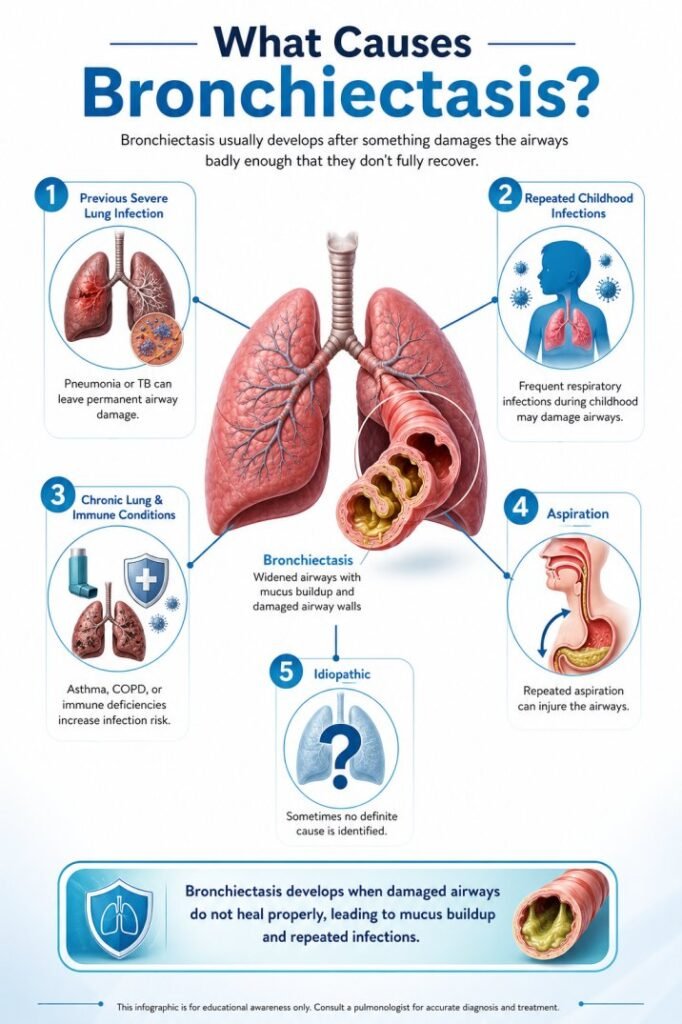
Bronchiectasis usually develops after something damages the airways badly enough that they don’t fully recover. In India, and in Hyderabad specifically, the most common causes we see include:
- A past severe lung infection, pneumonia or, very commonly, tuberculosis that has left scarring behind, even years after treatment was completed
- Uncontrolled or repeated childhood respiratory infections
- Underlying conditions such as poorly controlled asthma, COPD, or immune deficiencies that make the lungs more vulnerable to repeated infection
- Aspiration, food, acid reflux, or liquid repeatedly entering the airway instead of the food pipe
- In some cases, no clear cause is ever identified, which doctors call idiopathic bronchiectasis
Post-TB bronchiectasis deserves a special mention here. TB remains common in and around Hyderabad, and even after the infection is fully treated, the scarring it leaves behind in the airways can go on to cause bronchiectasis years later. If you’ve had TB in the past and now have a lingering cough, that history matters, mention it during your consultation even if it feels unrelated.
Bronchiectasis vs. COPD vs. Chronic Bronchitis: Why It Gets Missed
This is where most delayed diagnoses happen. Bronchiectasis, COPD, and chronic bronchitis all share a core symptom, a persistent, mucus-producing cough, and on a routine chest X-ray, bronchiectasis can be easy to overlook entirely.
The real difference shows up in the pattern and on the right scan:
- COPD is typically linked to long-term smoking and shows airflow obstruction on a spirometry test.
- Chronic bronchitis is a general description of a cough with mucus lasting most days for at least three months, in two consecutive years, it’s a symptom pattern, not a structural diagnosis.
- Bronchiectasis is a structural change in the airways themselves, visible on a High-Resolution CT (HRCT) scan of the chest, and it’s this scan, not a chest X-ray, that confirms it.
A patient can have COPD and bronchiectasis together, which is part of why treatment sometimes needs adjusting once the correct diagnosis is in place. If your cough has been labelled “chronic bronchitis” for years without an HRCT ever being done, it’s worth asking for one.
Warning Signs You Shouldn’t Ignore
Bronchiectasis rarely announces itself with one dramatic symptom. It tends to build gradually, which is exactly why it gets normalised. Signs worth paying attention to include:
- A daily cough that produces mucus, especially thick or discoloured mucus
- Chest infections that come back three or more times a year
- Coughing up small amounts of blood-streaked mucus
- Breathlessness that’s worse than expected for your age or fitness level
- Persistent fatigue and, in some cases, unintended weight loss
- A wheeze or crackling sound that a doctor can hear with a stethoscope
None of these confirm bronchiectasis on their own. But if two or three of them describe your last twelve months, it’s a reasonable enough pattern to get properly checked rather than waiting out another round of antibiotics.
How Dr. Waghray Diagnoses and Treats Bronchiectasis
Diagnosis starts with a detailed history, how long the cough has been present, how often infections recur, and whether there’s a history of TB, pneumonia, or reflux. From there, Dr. Kunal Waghray typically orders an HRCT chest scan to confirm airway changes, along with a sputum test to identify which bacteria are involved and a pulmonary function test to see how much the airflow is affected.
Treatment is built around breaking the mucus-infection cycle rather than chasing one infection at a time. Depending on severity, that can include:
- Airway clearance techniques, physiotherapy-based methods that help move mucus out of the lungs more effectively than coughing alone
- Targeted antibiotics during flare-ups, and sometimes a longer-term low-dose course for patients with frequent infections
- Inhaled medications to reduce inflammation and ease breathlessness
- Treating the underlying cause where one is identified, for instance, managing reflux, or optimising asthma or COPD control
- Pulmonary rehabilitation to rebuild lung capacity and stamina over time
- In advanced, localised cases, referral for surgical or interventional options is considered, though this applies to a minority of patients
The goal isn’t to “cure” the airway damage that’s already happened, that part is usually permanent, but to prevent further damage and cut down how often infections return.
What to Expect During Treatment
Most bronchiectasis care is managed on an outpatient basis, with periodic follow-up to track infection frequency and lung function over time. Early on, expect more frequent visits while your airway clearance routine and medication plan are being fine-tuned. Once things stabilise, follow-up typically shifts to every few months, with quicker check-ins if you notice a flare starting.
Patients often ask if this means daily physiotherapy forever. For many, yes, consistent airway clearance is what keeps the cycle from restarting, like how a diabetic manages blood sugar daily rather than only during a crisis. It becomes routine faster than most people expect.
The Takeaway
A cough that keeps coming back isn’t something to simply live with, and it isn’t always “just” chronic bronchitis or COPD. If your chest infections keep repeating and no one has ever ordered a CT scan to look closely at your airways, that’s a gap worth closing. Dr. Kunal Waghray sees patients for exactly this at KIMS – Sunshine Hospital, Begumpet, Monday to Saturday, contact us to book a consultation, or WhatsApp us to ask a quick question before you come in.
Meet Dr. Kunal, Pulmonologist & Critical Care Specialist in Hyderabad
Get expert care for bronchiectasis and other respiratory conditions. Schedule a consultation with Dr. Kunal for personalized diagnosis and treatment.
Frequently Asked Questions
Q: Is bronchiectasis the same as COPD?
A: No. COPD is airflow obstruction usually tied to smoking, while bronchiectasis is permanent widening and scarring of the airway walls, confirmed on an HRCT scan. The two can occur together, but they aren’t the same condition.
Q: Can bronchiectasis be cured completely?
A: The airway damage that’s already occurred is generally permanent, but with the right treatment, further damage can be slowed significantly and infection frequency reduced. Many patients live full, active lives once their care plan is in place.
Q: I had TB years ago and finished treatment. Can I still get bronchiectasis?
A: Yes. Scarring left behind after TB is one of the more common causes of bronchiectasis in India, and it can surface years after the infection itself is gone. A lingering cough after past TB treatment is worth getting checked.
Q: How is bronchiectasis diagnosed?
A: A High-Resolution CT (HRCT) scan of the chest is the standard test; a regular chest X-ray often misses it. Sputum tests and pulmonary function tests are usually done alongside it to guide treatment.
Q: When should I see a pulmonologist instead of waiting it out?
A: If you’ve had three or more chest infections in a year, a daily mucus-producing cough lasting several months, or you’re coughing up blood-streaked mucus, it’s time for a proper evaluation rather than another round of self-managed antibiotics.
This content is for educational purposes and isn’t a substitute for an in-person medical consultation. Please see a pulmonologist for diagnosis and treatment tailored to your condition.