




A holiday, a work trip, or a family visit shouldn’t feel complicated just because you live with a chronic lung condition, but flying with lung disease does need a bit more planning than it does for someone with healthy lungs. Airplane cabins carry less oxygen than you’re used to breathing on the ground, and for patients with asthma, COPD, or other chronic respiratory conditions, that difference is worth preparing for rather than discovering mid-flight. Dr. Kunal Waghray, a pulmonologist in Hyderabad at KIMS – Sunshine Hospital, Begumpet, regularly helps patients plan safe travel, and most of the time, flying with lung disease turns out to be completely manageable once the right checks are done beforehand. If you’re weighing whether it’s safe to book that ticket, an evaluation for flying with lung disease in Hyderabad is the place to start.
Why Does Flying Affect the Lungs Differently?
Airplane cabins are pressurised, but not to sea-level conditions. Cruising altitude cabin pressure is typically equivalent to standing at 6,000 to 8,000 feet above sea level, similar to being on a moderately high mountain. At that pressure, the air holds less oxygen than you’re used to at ground level.
For someone with healthy lungs, this drop is barely noticeable. For someone with asthma, COPD, or another chronic lung condition, the lower oxygen level can be enough to trigger breathlessness, fatigue, or a drop in blood oxygen saturation that wouldn’t happen on the ground. This is the core reason flying with lung disease deserves a bit of forward planning rather than a “we’ll figure it out” approach.
Who Should Get Checked Before Flying?
Not every patient with a lung condition needs a formal pre-flight assessment, but certain situations make it a good idea:
- A recent flare-up, chest infection, or hospitalization within the past six weeks
- COPD with FEV1 below 50% of predicted on your last lung function test
- Asthma that’s been poorly controlled recently, with frequent inhaler use
- Any history of needing supplemental oxygen, even occasionally
- A recent pneumothorax (collapsed lung) or lung surgery
- Coexisting heart conditions alongside your lung disease
If none of these apply and your condition is stable and well controlled, flying with lung disease is usually straightforward. If any of them do apply, it’s worth a consultation before you finalise travel plans, not after you’ve already booked.
What Happens During a Fit-to-Fly Assessment
A pre-flight evaluation typically includes checking your resting oxygen saturation with a pulse oximeter, reviewing your recent symptom control and medication use, and, where needed, a walk test to see how your oxygen levels respond to mild exertion, since that’s a reasonable stand-in for the demands of getting through an airport and settling into your seat.
If there’s a concern your oxygen levels might drop too low during the flight, your doctor may recommend in-flight supplemental oxygen, arranged through the airline in advance, or may simply confirm you’re fit to travel without any extra support. Either outcome is useful to know before your travel date, not after you’re already at the gate.
Practical Precautions for Flying With Lung Disease
Once you’re cleared to travel, a few simple habits make the flight itself more comfortable:
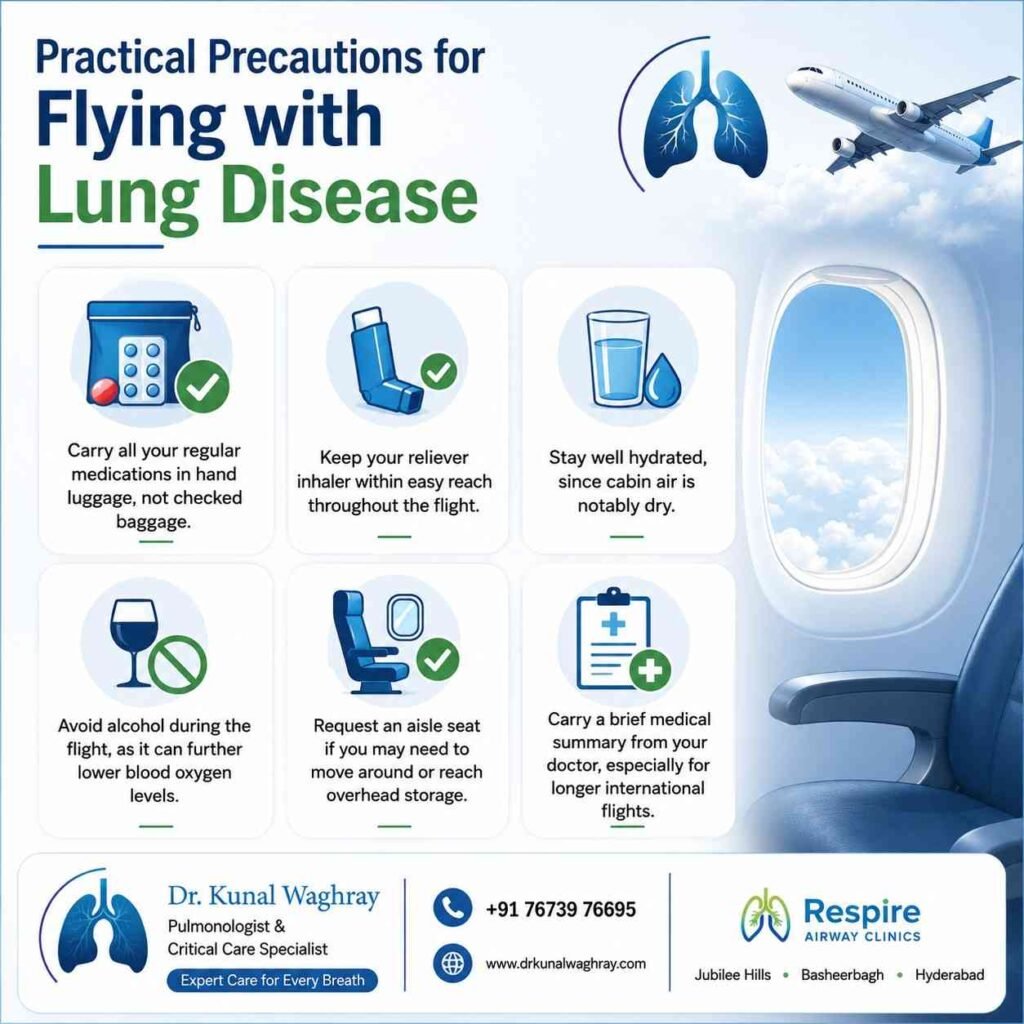
- Carry all your regular medications in hand luggage, not checked baggage, along with a few extra days’ supply in case of delays
- Keep your reliever inhaler within easy reach throughout the flight, not packed away in an overhead bin
- Stay well hydrated, since cabin air is notably dry and can thicken mucus or irritate sensitive airways
- Avoid alcohol during the flight, as it can further lower blood oxygen levels when combined with reduced cabin pressure
- Request an aisle seat if you may need to move around or reach overhead storage for medication
- Carry a brief medical summary from your doctor, especially for longer international flights, in case you need care while travelling
Special Considerations for Supplemental Oxygen Users
If you already use oxygen therapy, note that the emergency oxygen masks fitted on aircraft are for sudden cabin depressurisation only and cannot be used for routine in-flight oxygen needs. If your doctor recommends supplemental oxygen for the flight, you’ll need to arrange an FAA- or DGCA-approved portable oxygen concentrator through the airline well in advance, since not all carriers allow personal oxygen cylinders on board. This is one of the more common planning gaps we see, so it’s worth confirming directly with the airline as soon as your travel is booked, not the week before.
The Takeaway
Flying with lung disease doesn’t have to mean cancelling your travel plans. With the right pre-flight check and a few practical precautions, most patients with asthma, COPD, or other chronic lung conditions travel safely and comfortably. Dr. Waghray offers pre-travel pulmonary assessments at KIMS – Sunshine Hospital, Begumpet, Monday to Saturday. Contact us to book a check-up before your next trip, or WhatsApp us with any quick questions first.
Meet Dr. Kunal, Pulmonologist & Critical Care Specialist in Hyderabad
Get expert care for bronchiectasis and other respiratory conditions. Schedule a consultation with Dr. Kunal for personalized diagnosis and treatment.
Frequently Asked Questions
Q: Is it generally safe to fly with COPD or asthma?
A: Yes, for most patients with stable, well-controlled disease. Flying with lung disease becomes riskier mainly when the condition is unstable, recently flared, or when oxygen levels are already borderline on the ground.
Q: How soon before my flight should I get a fit-to-fly assessment?
A: Ideally a few weeks before travel, so there’s enough time to arrange in-flight oxygen with the airline if needed, rather than discovering the requirement at check-in.
Q: Can I use my own portable oxygen concentrator on the plane?
A: Many airlines allow FAA/DGCA-approved portable oxygen concentrators with prior approval, but personal oxygen cylinders are usually not permitted. Always confirm directly with your airline in advance.
Q: Will flying make my asthma or COPD worse long-term?
A: A single flight, properly prepared for, doesn’t cause lasting harm. The concern is short-term symptom management during the flight itself, not permanent lung damage from occasional air travel.
Q: What symptoms during a flight should prompt me to alert cabin crew?
A: Significant breathlessness beyond your normal baseline, chest pain, confusion, or bluish discolouration of lips or fingertips should be reported to cabin crew immediately rather than waited out.
This content is for educational purposes and isn’t a substitute for an in-person medical consultation. Please see a pulmonologist for diagnosis and treatment tailored to your condition.